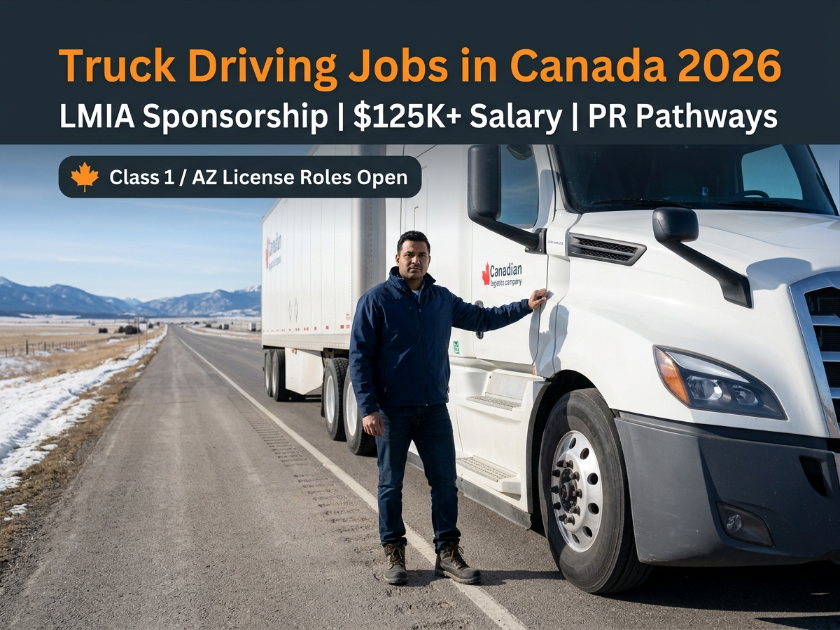
Canada’s Trucking Industry Has a Crisis — And Foreign Drivers Are the Solution
Canada’s truck driver shortage has reached critical levels in 2026. An aging domestic workforce, brutal long-haul schedules, harsh winter conditions, and exploding logistics demand have created a gap that Canadian employers simply cannot fill locally.
The result for foreign drivers: LMIA approvals are flowing, salaries are among the highest of any trade profession, and PR pathways are well-established and actively used.
For qualified, experienced truck drivers worldwide, Canada’s trucking sector offers something rare — a high-income career, employer-sponsored immigration, and a structured path to permanent residency all in one profession.
Key Fact: Long-haul truck drivers fall under NOC 73300 — one of Canada’s most immigration-friendly NOC codes, eligible for Express Entry CEC, multiple PNP streams, and RNIP sponsorship.
Truck Driver Salaries in Canada by Province (2026)
| Province | Hourly Wage | Annual Salary |
|---|---|---|
| Ontario | $27–$42/hr | $56,000–$97,000 |
| Alberta | $28–$44/hr | $60,000–$102,000 |
| British Columbia | $29–$47/hr | $62,000–$112,000 |
| Manitoba | $25–$40/hr | $52,000–$90,000 |
| Saskatchewan | $25–$42/hr | $52,000–$94,000 |
| Quebec | $24–$38/hr | $50,000–$82,000 |
| Atlantic Canada | $21–$33/hr | $44,000–$72,000 |
Income boosters:
- 🛣️ Long-haul drivers with per-mile pay, overtime, and bonuses can earn $125,000+/year
- 🌙 Night and weekend shift premiums standard across all provinces
- ☢️ Hazmat and fuel transport endorsements add $8,000–$15,000 annually
- ❄️ Reefer (refrigerated) and winter road premiums in northern routes
- 🏆 Owner-operator potential after gaining Canadian experience — unlimited earnings
Most In-Demand Truck Driving Jobs in Canada (2026)
Long-Haul Truck Driver (NOC 73300) — Cross-country and US–Canada border deliveries. Highest pay bracket. Weeks away from home. Most LMIA-sponsored foreign driver category in Canada.
Local / City Truck Driver — Urban deliveries, day shifts, stable lifestyle. Slightly lower pay than long-haul but significantly better work-life balance. Strong demand in Toronto, Calgary, and Vancouver.
Class 1 / AZ Tractor-Trailer Driver — Heavy combination vehicle operations. Highest demand in Ontario, Alberta, Saskatchewan, and Manitoba. Premium salary tier.
Fuel & Hazmat Transport Driver — Transporting fuel, chemicals, and dangerous goods. Requires special endorsements (TDG certification). Highest pay in the trucking sector.
Refrigerated (Reefer) Truck Driver — Transporting perishable food and pharmaceutical goods. Critical supply chain role. Year-round demand across all provinces.
Logging Truck Driver — Transporting timber in BC and Northern Canada. Physically demanding, remote locations. Strong LMIA availability and above-average wages.
Licensing Requirements: What Foreign Drivers Must Know
Canadian truck driving is federally and provincially regulated — your home country license alone is not sufficient for long-term employment.
| License Stage | Requirements |
|---|---|
| On arrival | International CDL accepted temporarily (60–90 days) |
| Canadian license conversion | Must pass provincial written + practical tests |
| Class 1 / AZ license | Required for tractor-trailers — road test mandatory |
| Air brake endorsement | Required for most heavy commercial vehicles |
| TDG certification | Required for hazmat and fuel transport roles |
| FAST card | Required for US–Canada border crossing drivers |
Pro tip: Many LMIA-approved employers actively assist foreign drivers with provincial license conversion, air brake testing, and training costs — negotiate this as part of your job offer before signing.
Basic Requirements for Foreign Truck Drivers
- ✅ Commercial driving experience: 1–2 years minimum with heavy trucks or trailers
- ✅ Clean driving record: No DUI, license suspensions, or serious collision history
- ✅ Clean criminal background: Essential for LMIA approval and US border clearance
- ✅ Physical fitness: Long hours, loading/unloading, extreme weather operation
- ✅ English proficiency: Logbooks, border compliance, safety communication
- ✅ Valid work authorization: LMIA work permit, open work permit, or PR status
How Foreign Truck Drivers Get Jobs in Canada: Step-by-Step
Step 1: Target LMIA-Sponsoring Trucking Companies
Key employers actively sponsoring foreign drivers: TFI International, Challenger Motor Freight, Bison Transport, Day & Ross, Kingsway Transport, J&R Hall Transport, and hundreds of mid-sized regional carriers across Ontario, Alberta, and Manitoba.
Mid-sized regional carriers consistently process LMIA applications faster than large national fleets — target both for maximum opportunity.
Step 2: Employer Applies for LMIA
Trucking LMIA applications are among Canada’s most consistently approved due to systemic, documented, and long-standing driver shortages across all provinces. Employers provide evidence of recruitment attempts before LMIA approval — a formality in most trucking cases.
Step 3: Apply for Canadian Work Permit
Required documents:
- Valid passport
- LMIA approval letter
- Signed job offer
- Commercial driving license and abstract
- Police clearance certificate
- Medical examination (including vision and physical fitness)
- Passport-size photos + biometrics
Step 4: Arrive, Get Licensed, and Start Driving
Complete provincial license conversion → pass air brake endorsement → complete employer orientation and safety training → begin earning within weeks of arrival.
Best Provinces for Truck Driver Jobs and Immigration
| Province | Why It Stands Out |
|---|---|
| Manitoba (Winnipeg) | Easiest LMIA process, strongest PNP for truck drivers, central hub |
| Saskatchewan | High demand, simpler licensing conversion, active PNP nomination |
| Alberta (Calgary, Edmonton) | Highest salaries, oil and energy sector logistics demand |
| Ontario (Toronto, Brampton, Mississauga) | Largest trucking market in Canada — massive employer base |
| British Columbia | Highest hourly rates, port logistics, more complex licensing steps |
PR Pathways for Truck Drivers in Canada
Truck driving is one of Canada’s most PR-connected trade professions with multiple active immigration streams:
Provincial Nominee Programs (PNP) — Manitoba, Saskatchewan, Alberta, Ontario, and Atlantic provinces all actively nominate truck drivers. Manitoba’s PNP in particular has a strong track record of nominating NOC 73300 applicants. A provincial nomination adds 600 CRS points — near-guaranteeing a PR invitation.
Canadian Experience Class (Express Entry) — After 12 months of eligible Canadian truck driving experience, foreign drivers qualify for CEC — one of the fastest routes to permanent residency available in Canada.
Rural & Northern Immigration Pilot (RNIP) — Small communities across Canada’s prairie and northern regions frequently sponsor truck drivers for PR in exchange for settlement commitments — ideal for drivers open to non-urban locations.
Atlantic Immigration Program (AIP) — Trucking employers in Atlantic Canada can directly sponsor drivers for permanent residency after qualifying employment periods.
Honest Challenges of Truck Driving in Canada
| Challenge | Reality |
|---|---|
| Extended time away from home | Long-haul routes mean weeks away — difficult for families |
| Harsh Canadian winters | Ice roads, snowstorms, and black ice are genuine hazards |
| Fatigue and hours of service rules | Federal HOS regulations strictly limit driving hours |
| Logbook and paperwork compliance | ELD (electronic logging device) mandatory — errors are penalized |
| Physical demands | Loading, unloading, and extended sitting cause physical strain |
| Border crossing compliance | US–Canada crossings require extensive documentation |
Drivers who prepare mentally and physically for these realities build long careers. Those who don’t often exit the industry within the first year.
Frequently Asked Questions
Q: Can I get a truck driving job in Canada without Canadian experience? A: Yes — with 1–2 years of verifiable foreign commercial driving experience, LMIA sponsorship is available. Canadian license conversion is required after arrival.
Q: Which province has the easiest LMIA for truck drivers? A: Manitoba and Saskatchewan have the strongest LMIA approval track records for NOC 73300, combined with the most accessible PNP nomination streams.
Q: How much can a truck driver earn in Canada in 2026? A: Entry-level positions start at $52,000–$56,000 annually. Experienced long-haul drivers with overtime and bonuses regularly earn $100,000–$125,000+ per year.
Q: Do I need a Class 1 / AZ license before coming to Canada? A: No — many LMIA employers hire based on foreign CDL experience and assist with Canadian Class 1/AZ conversion after arrival. Confirm this during the job offer negotiation.
Q: Can truck driving lead to Canadian PR? A: Yes — through PNP nomination, Canadian Experience Class (Express Entry), AIP, or RNIP after gaining qualifying Canadian work experience.
Final Verdict: Is Truck Driving the Right Canada Immigration Path for You?
| Your Profile | Recommendation |
|---|---|
| 1–2 years commercial driving experience | ✅ Strong LMIA candidate — immediate pathway available |
| Clean driving and criminal record | ✅ Essential — and fully qualifies you |
| Willing to work long-haul routes | ✅ Highest pay tier — $100K+ realistic |
| Targeting Canadian PR | ✅ PNP, CEC, AIP all actively used by truck drivers |
| Open to Manitoba or Saskatchewan | ✅ Easiest LMIA + strongest PNP nomination history |
| Seeking owner-operator potential | ✅ Achievable after 2–3 years of Canadian experience |
| Have family concerns about time away | ⚠️ Consider local/city driving roles for better work-life balance |
Bottom line: Truck driving in Canada in 2026 remains one of the highest-paid, most immigration-friendly, and most in-demand trade careers available to foreign workers worldwide. With salaries reaching $125,000+, consistent LMIA approvals, and well-established PR pathways through PNP and Express Entry, qualified foreign drivers who prepare properly are virtually guaranteed a stable career and a realistic path to Canadian permanent residency.
Disclaimer: Licensing requirements, LMIA conditions, and immigration pathways change regularly. Always verify current requirements with IRCC (ircc.canada.ca), your provincial transportation authority, and a licensed Canadian immigration consultant before applying.