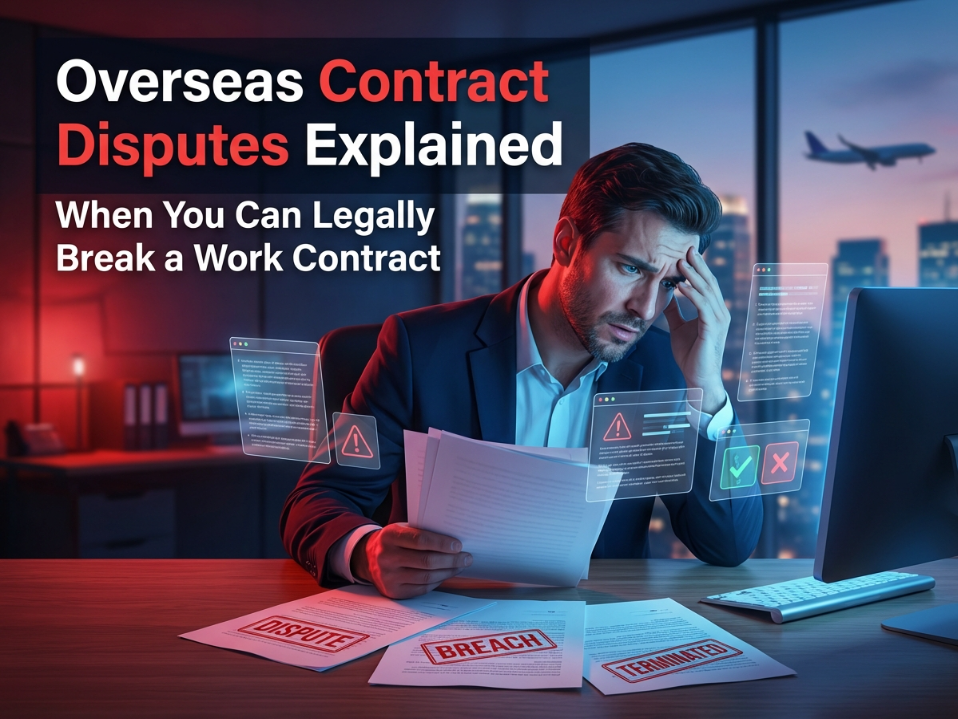
Overseas Contract Disputes Explained: When You Can Legally Break a Work Contract
Most expats believe breaking a work contract abroad is impossible — or that doing so will automatically get them banned, fined, or deported. That belief keeps thousands of workers trapped in toxic workplaces, illegal employment situations, and abusive conditions.
The truth is very different: You can legally break a work contract abroad, but only if you understand the legal grounds, the evidence required, and the risks involved. Most workers don’t lose their cases because they’re wrong — they lose because they don’t know the exact conditions under which international labor laws allow early termination.
This guide exposes the real rules behind overseas contract disputes and explains exactly when you can legally walk away from a contract without penalties, bans, or employer retaliation.
Why Contract Disputes Are More Common in 2026
Global hiring is expanding, but employer compliance is not keeping up. This creates a perfect storm of disputes.
Key reasons include:
- Misleading job offers
- Working conditions not matching the contract
- Salary discrepancies
- Overtime exploitation
- Unsafe workplaces
- Delayed visa processing
- Employer manipulation of sponsorship rules
- Contract substitution (illegal)
Foreign workers often feel powerless, but labor laws in 2026 are far more protective — if you use them correctly.
Understanding How Work Contracts Function Abroad
A work contract abroad is not just a written agreement. It is legally tied to:
- Immigration status
- Sponsorship rules
- Labor laws
- Wage protection systems
- Visa duration
- Residency rights
This means: Breaking a contract is not just a job issue — it becomes a legal and immigration issue at the same time.
To act safely, you must understand when the law is on your side.
When You Can Legally Break a Work Contract Abroad
These are the legally recognized grounds across most international labor systems, including Gulf countries, Europe, East Asia, and major expat destinations.
Legal Ground 1: Employer Breach of Contract
If your employer breaks the agreement first, you are legally permitted to exit.
Examples include:
- Not paying salary on time
- Paying less than the contracted amount
- Reducing benefits without consent
- Changing job role or duties illegally
- Forcing you to work in unsafe conditions
- Not providing agreed accommodation or transport
- Refusing to renew your visa on time
An employer breach invalidates mandatory contract continuation.
Legal Ground 2: Salary Delays or Non-Payment
In most countries, even a single month of unpaid salary is considered a contract breach.
If salary is delayed repeatedly or withheld, workers may legally:
- File a complaint
- Suspend work (where permitted)
- Break the contract
- Transfer to another employer
Wage Protection Systems (WPS) make salary violations extremely serious for employers in the Gulf.
Legal Ground 3: Dangerous or Unhealthy Work Conditions
Labor laws globally require employers to:
- Provide a safe workplace
- Offer proper protective equipment
- Avoid excessive heat exposure
- Maintain reasonable working hours
- Prevent mental abuse and harassment
If conditions threaten your health or safety, you can legally leave the job even without notice.
Examples include:
- Hazardous job tasks without training
- Toxic chemicals exposure
- Repeated harassment by supervisors
- Unsafe housing provided by employer
Documentation is essential to prove your case.
Legal Ground 4: Contract Substitution (A Major Expat Problem)
Contract substitution is when: You sign one contract in your home country → You are forced to sign a different one after arrival.
This is illegal in:
- UAE
- Saudi Arabia
- Qatar
- Kuwait
- Bahrain
- Oman
- Most EU countries
- East Asia
You can legally break the contract and file a complaint if:
- Salary is lower than agreed
- Job role has changed
- Working hours are increased
- Benefits are reduced
Contract substitution is one of the strongest legal grounds for early exit.
Legal Ground 5: Employer Violates Visa or Residency Laws
If your sponsor fails to:
- Renew your residency ID
- Pay visa fees
- Provide health insurance
- Maintain legal sponsorship
You can terminate the contract safely because working illegally — even unintentionally — puts you at risk, not them.
Many expats do not realize they can leave immediately if their employer’s sponsorship status becomes illegal.
Legal Ground 6: Forced Labor, Threats, or Coercion
Any form of:
- Threats
- Confiscation of passport
- Forced overtime
- Withholding your exit
- Forcing you to pay illegal fees
… qualifies as coercion, which allows workers to break contracts under international labor law.
This applies strongly in:
- UAE
- Qatar
- Saudi Arabia
- Bahrain
- Oman
Governments penalize employers heavily for these violations.
Legal Ground 7: Medical or Health Ineligibility
If you become medically unfit to perform the job:
- Doctor’s report
- Government medical test
- Injury at workplace
… you may legally terminate the contract without penalty.
This prevents forced labor and employer exploitation of health conditions.
Legal Ground 8: Employer Files False Absconding or Discipline Cases
If your employer:
- Files a fake absconding report
- Accuses you of misconduct without proof
- Uses disciplinary procedures to intimidate you
You may terminate the contract legally AND counter-file:
- Defamation
- Abuse of power
- Visa misuse
Absconding cases, if unjustified, are illegal employer behavior.
Legal Ground 9: Exploitation Beyond Legal Working Hours
If the employer violates:
- Maximum working hours
- Overtime laws
- Rest-day requirements
- Rest between shifts
You can legally exit after documenting the violations.
Labor courts take overtime exploitation very seriously.
Legal Ground 10: Employer Blocks Your Resignation
In many countries, especially in the Gulf, employers try to force workers to continue working even after resignation.
This is illegal.
If you:
- Submit resignation properly
- Serve the notice period
- Follow the labor law
… the employer cannot refuse to release you.
Blocking your exit becomes a legal breach, allowing you to end the contract without penalty.
When You CANNOT Break a Contract Without Consequences
These situations often lead to penalties or bans:
Leaving during probation without legal notice Some countries require:
- 14 days
- 30 days
- Employer transfer fees
Abandoning the job without informing HR This is treated as absconding.
Leaving because of personal reasons Family matters are not considered legal grounds.
Disliking the work This is not a legal violation.
Better job offers Unless permitted by law, you must follow proper resignation procedures.
If you break a contract without legal grounds, you risk:
- Visa cancellation
- Re-entry ban
- Financial penalties
- Loss of end-of-service benefits
How to Protect Yourself Before Breaking a Contract
Smart expats follow a clear legal process.
- Gather Evidence Before You Resign — Emails, payslips, photos, messages, official letters.
- File a complaint before leaving the company — When filed officially, you are legally protected.
- Never leave the country until your case is closed — Leaving destroys your position.
- Keep communication factual, not emotional — You need clean evidence.
- Consult labor ministry guidelines — Most countries publish clear rules.
- Understand your notice period — Breaking notice requirements may cost you money.
Common Employer Tricks and How to Defend Yourself
Employers often manipulate workers during disputes.
Trick 1: Forcing you to sign resignation letters Never sign without understanding.
Trick 2: Threatening visa cancellation Illegal if you filed a dispute.
Trick 3: Offering partial settlement verbally Always demand written approval.
Trick 4: Changing job roles to push you out Document everything.
Trick 5: Filing absconding cases Counter-file immediately at the labor office.
How Labor Courts View Contract Disputes
Courts don’t rely on emotion — they rely on:
- Contract terms
- Employer compliance
- Documentation
- Wage records
- Legally proven violations
If your employer violated the contract first, courts almost always rule in your favor.
Final Thoughts
Breaking a work contract overseas is not reckless — it’s legal, if done with the right grounds and proper documentation. Most expats stay trapped in abusive jobs because they don’t understand their rights. But labor laws in 2026 are clear:
If the employer breaks the law, you are not obligated to stay.
If you act strategically, follow the legal procedures, and understand your protections, you can leave a job safely — even in countries with strict sponsorship systems.
Your contract is a legal agreement, not a prison sentence. Know the rules, use the law correctly, and protect your future abroad.