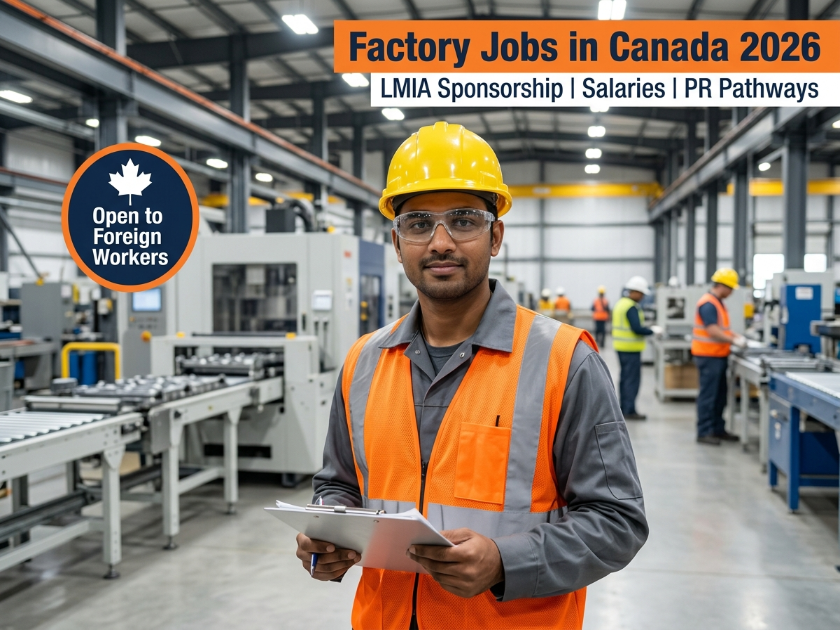
Canada’s Factories Are Hiring — And Foreign Workers Are a Priority
Canada’s manufacturing and industrial sector faces a persistent and growing labor shortage in 2026. From food processing plants in Manitoba to automotive assembly lines in Ontario and seafood factories in British Columbia — employers cannot fill positions fast enough using local labor alone.
For foreign workers, this creates a genuine and structured opportunity: LMIA approvals are consistently available, entry requirements are accessible, and multiple PR pathways exist after gaining Canadian work experience.
Key Fact: Factory and manufacturing roles fall under NOC 94 and 95 categories — eligible for Provincial Nominee Programs, Agri-Food Pilot, and Canadian Experience Class immigration streams.
Factory Worker Salaries in Canada by Province (2026)
| Province | Hourly Wage | Monthly Earnings |
|---|---|---|
| Ontario | $18–$25/hr | $3,000–$4,200 |
| British Columbia | $18–$26/hr | $3,100–$4,300 |
| Alberta | $18–$27/hr | $3,100–$4,400 |
| Saskatchewan | $17–$23/hr | $2,900–$3,600 |
| Manitoba | $17–$23/hr | $2,900–$3,600 |
| Quebec | $17–$24/hr | $2,900–$3,800 |
| Atlantic Canada | $16–$21/hr | $2,700–$3,400 |
Salary boosters:
- 🌙 Night shift premiums (+$2–$4/hr)
- 🏭 Specialized roles: Machine operators and forklift drivers earn $26–$33/hr
- ⏰ Overtime pay — widely available in production-heavy facilities
- 📦 Seasonal bonuses in food and agricultural processing
Types of Factory Jobs Available in Canada
Food Processing Worker — Packaging, sorting, cutting food products. Top demand in Ontario, Manitoba, Alberta, and Quebec. LMIA widely available.
Assembly Line Worker — Automotive and electronics production. Repetitive assembly, quality checks, hand tools. No experience often required.
Machine Operator — Operating and monitoring industrial machinery. Minor troubleshooting experience preferred. Higher pay band.
Packaging Worker — Product packing, labeling, quality control. Among the most LMIA-accessible roles for beginners.
Quality Control Technician — Inspecting products and recording defects. Semi-skilled role with faster career progression.
Forklift/Heavy Equipment Operator — Certification required. Significantly higher wages. Strong demand in warehouse-linked factory roles.
Factory Sanitation Worker — Cleaning machines and maintaining hygiene in food facilities. High demand, accessible entry point.
Basic Requirements to Work in a Canadian Factory
- ✅ Physical fitness — standing long shifts, lifting 20–50 lbs regularly
- ✅ Basic English — for safety instructions, teamwork, and reporting
- ✅ Clean criminal record — especially for food and medical manufacturing
- ✅ Punctuality and reliability — attendance records directly affect LMIA renewals
- ✅ Valid work authorization — LMIA work permit, open work permit, or PR status
⚠️ Visitor visas do not permit factory employment in Canada under any circumstance.
How Foreign Workers Get Factory Jobs in Canada: Step-by-Step
Step 1: Apply to LMIA-Sponsoring Employers
Target food processing plants, automotive factories, packaging companies, and beverage manufacturers. Mid-sized factories have the highest LMIA approval rates and fastest hiring timelines.
Step 2: Employer Obtains LMIA Approval
The Labour Market Impact Assessment authorizes the employer to hire a foreign worker. Factory LMIA applications succeed frequently due to documented local labor shortages and high turnover rates.
Step 3: Apply for Your Canadian Work Permit
Documents required: Valid passport, LMIA approval letter, signed job offer, police clearance certificate, medical exam results, passport photos, biometrics.
Step 4: Arrive and Begin Work
Most factories provide immediate orientation, safety training, and on-the-job machine training upon arrival. Labor demand means workers often start within days of landing.
Best Provinces for Factory Jobs in 2026
| Province | Key Industries |
|---|---|
| Ontario | Automotive, electronics, plastics, food processing |
| Alberta | Industrial manufacturing, food and meat processing |
| Manitoba | Meat packing, food factories, packaging |
| Saskatchewan | Agricultural processing, industrial plants |
| British Columbia | Seafood, food packaging, industrial production |
| Atlantic Canada | Seasonal food processing, AIP-eligible employers |
PR Pathways for Factory Workers
Factory work experience directly supports multiple Canadian permanent residency streams:
Provincial Nominee Program (PNP) — Manitoba, Saskatchewan, Alberta, Nova Scotia, and New Brunswick actively nominate factory and manufacturing workers facing critical shortages.
Agri-Food Pilot — Specifically designed for food processing and meat production workers. One of the most direct PR routes for factory employees.
Atlantic Immigration Program (AIP) — Factory roles in Atlantic Canada qualify for employer-supported permanent residency applications.
Canadian Experience Class (Express Entry) — After 12 months of skilled Canadian work experience, factory workers in eligible NOC categories can apply through Express Entry.
Rural & Northern Immigration Pilot (RNIP) — Small-town factories sponsor workers directly for PR in exchange for community settlement commitment.
Skills That Maximize Your Hiring Chances
- 🔧 Prior manufacturing or assembly experience
- 🚜 Forklift or heavy equipment certification
- ⏱️ Strong time management and quota efficiency
- 🦺 Safety awareness and WHMIS knowledge
- 💪 Physical endurance for extended shifts
- 📋 Basic report writing for QC roles
Even complete beginners can develop most of these skills within the first few weeks on the job.
Common Mistakes That Hurt Factory Job Applications
| Mistake | Consequence |
|---|---|
| Applying on a visitor visa | Illegal — immediate disqualification |
| Non-Canadian resume format | Screened out before review |
| Overstating physical ability | Safety risk flagged during orientation |
| Ignoring night shift availability | Significantly fewer job offers |
| Missing required documents | Work permit application delayed or rejected |
Frequently Asked Questions
Q: Can I get a factory job in Canada without experience? A: Yes — food processing, packaging, and general labor roles regularly hire beginners. On-the-job training is standard.
Q: Which province has the easiest LMIA approval for factory workers? A: Manitoba, Saskatchewan, and Atlantic Canada have the highest LMIA approval rates due to severe and documented labor shortages.
Q: Can a factory job lead to Canadian PR? A: Yes — through the Agri-Food Pilot, PNP, AIP, or Canadian Experience Class after 12 months of eligible work experience.
Q: Do I need to speak French for factory jobs in Quebec? A: Basic French is strongly recommended. However, some large food factories in Quebec hire English-speaking workers for floor-level production roles.
Final Verdict: Are Factory Jobs Worth Pursuing in Canada in 2026?
| Your Profile | Recommendation |
|---|---|
| No formal education or degree | ✅ Factory jobs are fully accessible |
| Seeking LMIA sponsorship | ✅ Among the highest approval rates |
| Targeting Canadian PR | ✅ Multiple direct pathways available |
| Willing to work night/rotating shifts | ✅ Higher pay + faster hiring |
| Located near Atlantic Canada | ✅ AIP direct PR sponsorship eligible |
| Seeking career advancement | ✅ Operator → Supervisor → Manager track |
Bottom line: Canada factory jobs in 2026 remain one of the most realistic, accessible, and immigration-friendly employment pathways for foreign workers — regardless of education level or prior experience. With LMIA approvals consistently available, competitive wages, and direct PR streams like the Agri-Food Pilot and PNP, the factory sector offers far more than just a job — it offers a structured path to Canadian permanent residency.
Disclaimer: Immigration rules and LMIA conditions change frequently. Always verify current requirements with IRCC (ircc.canada.ca) and your nearest Canadian visa application center.