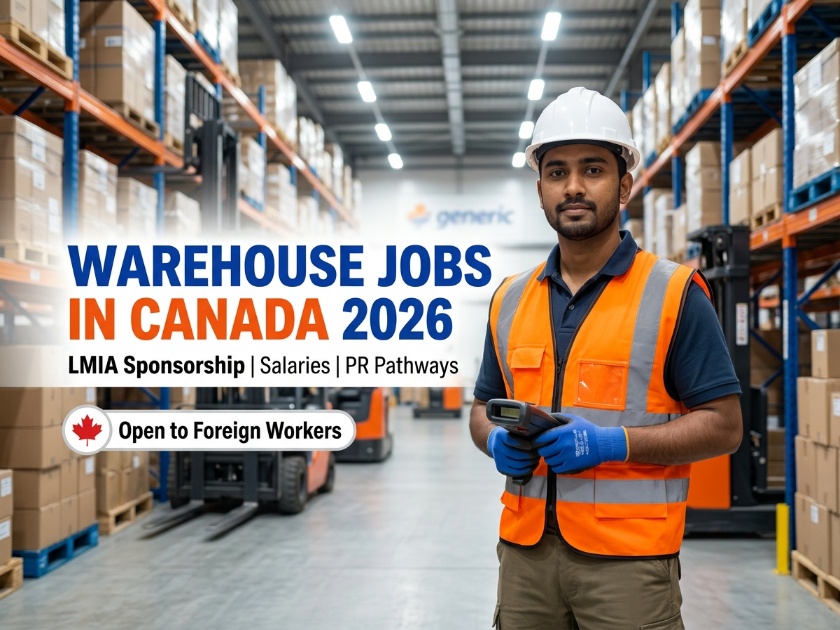
Canada’s Warehouse Industry Is Expanding — And Actively Hiring Foreign Workers
Canada’s logistics and warehousing sector is one of the fastest-growing employment markets in 2026. Fueled by explosive e-commerce growth, expanding national distribution networks, and persistent local labor shortages, major employers including Amazon, Walmart, Costco, FedEx, DHL, and Purolator are consistently unable to fill positions using domestic workers alone.
For foreign workers, this creates a structured, accessible, and well-paying opportunity — with LMIA approvals readily available, clear entry requirements, and multiple PR pathways after gaining Canadian experience.
Key Fact: Warehouse and logistics roles fall under NOC 14400, 74100, and 75100 — categories eligible for Provincial Nominee Programs, Atlantic Immigration Program, and Canadian Experience Class.
Warehouse Worker Salaries in Canada by Province (2026)
| Province | Hourly Wage | Monthly Earnings |
|---|---|---|
| Ontario | $17–$25/hr | $2,900–$4,000 |
| British Columbia | $18–$26/hr | $3,000–$4,200 |
| Alberta | $18–$26/hr | $3,000–$4,300 |
| Saskatchewan | $16–$22/hr | $2,700–$3,500 |
| Manitoba | $16–$21/hr | $2,700–$3,400 |
| Quebec | $16–$23/hr | $2,700–$3,700 |
| Atlantic Canada | $15–$20/hr | $2,500–$3,400 |
Salary boosters:
- 🌙 Night shift premiums (+$2–$4/hr)
- 🚜 Forklift operators and supervisors earn $25–$35/hr
- ⏰ Overtime widely available during peak seasons
- 🎁 Holiday and peak-season bonuses at major employers
- 📦 Amazon and large fulfillment centers offer structured pay increases every 6–12 months
Most In-Demand Warehouse Jobs in Canada (2026)
Warehouse Associate / General Laborer — Entry-level, no experience required. Picking orders, packing boxes, scanning products, loading trucks. Most LMIA-accessible role for beginners.
Forklift Operator — Certified, high-paying role. Operating forklifts, moving pallets, loading containers. Certification dramatically increases salary and hiring speed.
Material Handler — Moving inventory, operating pallet jacks, heavy lifting. High physical demand but widely available across all provinces.
Order Picker — Locating products, scanning orders, preparing shipments. Common in e-commerce fulfillment centers like Amazon and Walmart.
Shipping & Receiving Clerk — Processing inbound/outbound shipments, coordinating with carriers, creating shipping documents. Semi-skilled with faster pay progression.
Inventory Clerk — Stock audits, inventory counts, reporting discrepancies. Requires basic computer skills. Strong stepping stone to supervisory roles.
Warehouse Supervisor — Leading teams, managing schedules, monitoring KPIs. Requires prior experience but offers significantly higher compensation.
Basic Requirements for Warehouse Jobs in Canada
- ✅ Physical fitness — standing long shifts, lifting 20–50 lbs consistently
- ✅ Basic English — essential for safety compliance, instructions, and teamwork
- ✅ Clean criminal record — police clearance required for most employers
- ✅ Shift flexibility — day, evening, night, and rotating schedules are standard
- ✅ Valid work authorization — LMIA work permit, open work permit, or PR status
⚠️ Visitor and tourist visas do not permit warehouse employment in Canada under any circumstances.
Skills That Maximize Your Hiring Chances
- 🚜 Forklift certification — single biggest differentiator for higher pay and faster hiring
- 📦 Pallet jack and material handling experience
- 💻 Warehouse Management System (WMS) familiarity
- 🚚 Shipping and receiving documentation experience
- 🦺 Safety compliance and WHMIS awareness
- ⏱️ Reliability, punctuality, and time management
Pro tip: Foreign applicants with valid forklift certification are among the most actively recruited warehouse workers in Canada — particularly in Ontario, Alberta, and BC.
How Foreign Workers Get Warehouse Jobs in Canada: Step-by-Step
Step 1: Target LMIA-Sponsoring Employers
Major employers actively hiring foreign workers: Amazon Canada, Walmart, Costco, FedEx, DHL, Purolator, Sobeys, Canadian Tire, Bulk Barn, and large third-party logistics (3PL) companies.
Mid-sized regional warehouses and distribution centers often process LMIA applications faster than major corporations.
Step 2: Employer Applies for LMIA Approval
Warehouses consistently qualify for LMIA approval due to high turnover rates, year-round operational demand, and documented local labor shortages. The logistics sector is one of Canada’s most LMIA-active industries.
Step 3: Apply for Your Canadian Work Permit
Documents required:
- Valid passport
- LMIA approval letter
- Signed job offer letter
- Police clearance certificate
- Medical examination results
- Passport-size photos
- Biometrics enrollment
Step 4: Arrive and Begin Work
Orientation covers safety protocols, warehouse procedures, equipment operation, and productivity expectations. Most warehouses begin new workers within days of arrival due to high operational demand.
Best Provinces for Warehouse Jobs in 2026
| Province | Key Employers & Industries |
|---|---|
| Ontario (Toronto, Brampton, Mississauga) | Amazon, FedEx, Walmart — largest warehouse market in Canada |
| British Columbia (Vancouver, Surrey) | E-commerce fulfillment, port logistics, retail distribution |
| Alberta (Calgary, Edmonton) | Industrial warehousing, energy sector logistics |
| Manitoba (Winnipeg) | Central Canada distribution hub, strong LMIA history |
| Atlantic Canada | AIP-eligible employers, growing fulfillment sector |
PR Pathways for Warehouse Workers in Canada
Warehouse experience directly supports multiple permanent residency streams:
Provincial Nominee Program (PNP) — Manitoba, Saskatchewan, Alberta, and Nova Scotia actively nominate logistics and warehouse workers to address critical shortages. A provincial nomination adds 600 CRS points — nearly guaranteeing a PR invitation through Express Entry.
Atlantic Immigration Program (AIP) — Designated warehouse employers in New Brunswick, Nova Scotia, PEI, and Newfoundland can sponsor workers for PR after 6–12 months of employment.
Canadian Experience Class (Express Entry) — After 12 months of eligible Canadian work experience, warehouse workers in qualifying NOC categories can apply directly for permanent residency through Express Entry.
Rural & Northern Immigration Pilot (RNIP) — Warehouses in smaller Canadian communities sponsor workers for PR in exchange for community settlement commitments.
Challenges of Warehouse Work in Canada
| Challenge | Reality |
|---|---|
| Physical intensity | Long shifts, heavy lifting, constant movement |
| Repetitive tasks | Same duties daily — mental stamina required |
| Shift work | Night, early morning, rotating schedules common |
| Temperature extremes | Cold storage facilities and warm summer warehouses |
| Strict productivity quotas | Major employers like Amazon track performance closely |
| Safety compliance | WHMIS and safety rules strictly enforced |
Understanding these realities before applying ensures better preparation and longer retention — which directly benefits LMIA renewal and PR applications.
Frequently Asked Questions
Q: Can I get a warehouse job in Canada without experience? A: Yes — general laborer, order picker, and warehouse associate roles regularly hire complete beginners. Training is provided on-site.
Q: Which province has the easiest LMIA approval for warehouse workers? A: Manitoba, Alberta, and Atlantic Canada provinces have the strongest LMIA approval history for logistics and warehouse roles.
Q: Does forklift certification from my home country count in Canada? A: Foreign certifications may need to be validated provincially. Many employers offer recertification training upon hiring — confirm with the specific employer during the application process.
Q: Can a warehouse job lead to Canadian PR? A: Yes — through PNP, AIP, or Canadian Experience Class (Express Entry) after 12 months of qualifying Canadian work experience.
Q: Do I need French for warehouse jobs in Quebec? A: Basic French is helpful. However, large distribution centers in Quebec often hire English-speaking workers for floor-level positions.
Final Verdict: Are Warehouse Jobs the Right Canada Immigration Path for You?
| Your Profile | Recommendation |
|---|---|
| No formal degree or education | ✅ Fully accessible — no degree required |
| Seeking LMIA sponsorship | ✅ Among the highest approval rates in Canada |
| Have forklift certification | ✅ Fast-tracked hiring + higher wages |
| Willing to work night/rotating shifts | ✅ Higher pay + increased job offers |
| Targeting Canadian PR | ✅ PNP, AIP, and CEC pathways all available |
| Located near Atlantic Canada | ✅ AIP direct employer sponsorship available |
Bottom line: Canada warehouse jobs in 2026 remain one of the most accessible, consistently sponsored, and PR-friendly employment pathways available to foreign workers — regardless of education level or prior experience. With major employers actively recruiting internationally, LMIA approvals flowing steadily, and multiple direct PR streams available, the warehouse sector offers far more than a paycheck — it offers a real and structured path to Canadian permanent residency.
Disclaimer: Immigration pathways and LMIA conditions are subject to change. Always verify current requirements with IRCC (ircc.canada.ca) and your nearest Canadian visa application center before applying.